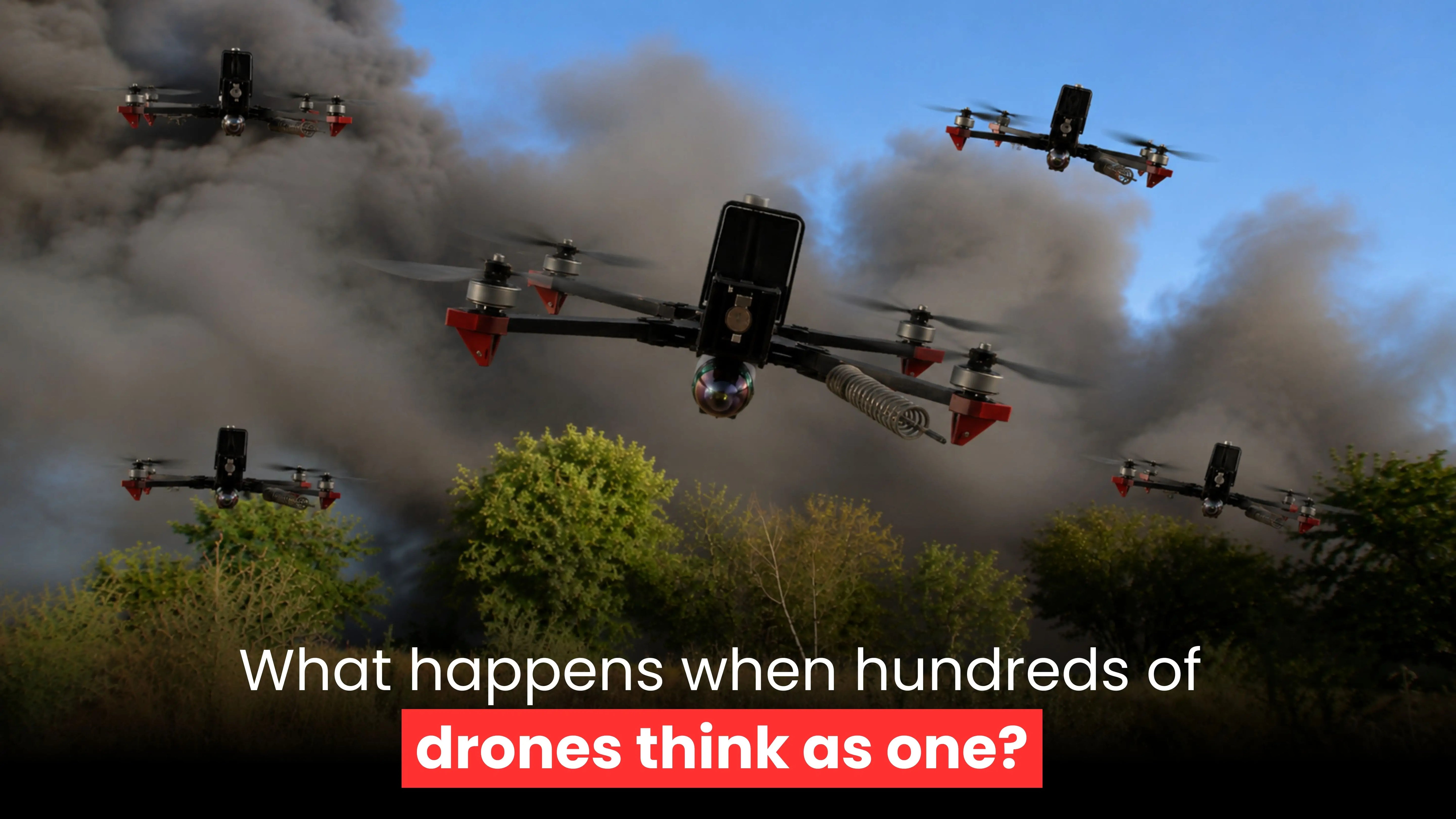

When governments decide which industries deserve long-term support, they reveal where they believe the future economy is headed.
That is why one section of the newly announced Gujarat Industrial Policy 2026 deserves the attention of every drone manufacturer in India.
For the first time, drone manufacturing has been identified as a special thrust sector under Gujarat's industrial growth strategy, placing it alongside technologies that are expected to define the next generation of manufacturing and innovation. This is not merely a financial decision. It is a strategic acknowledgement that drones are becoming an essential part of India's industrial and national security future.
At a time when the Indian Armed Forces are accelerating drone adoption across surveillance, border monitoring, logistics support, intelligence gathering, and autonomous operations, the policy sends a clear message: India wants to build these capabilities at home.
Why Drone Manufacturers Should Pay Attention
Many industrial policies offer generic benefits across sectors. Gujarat's approach is different.
The state has identified drone manufacturing as a priority area capable of driving innovation, creating skilled employment, strengthening domestic supply chains, and supporting export-led growth. More importantly, drone manufacturers are eligible for some of the highest incentive structures available under the policy. Eligible companies can receive benefits amounting to 45% to 50% of their investment through a combination of capital subsidies, interest subsidies, and power tariff support.
For a drone company, this is significant.
Unlike traditional manufacturing businesses, drone manufacturers continuously invest in product development, testing facilities, flight validation infrastructure, software engineering, payload integration, electronics design, and compliance requirements. Every rupee saved through incentives can be redirected toward innovation and capability development.
The companies that leverage these benefits effectively may gain a significant advantage in the race to scale.
The Policy Solves a Problem That Has Limited Growth
India's drone sector has made remarkable progress over the last few years, but scaling manufacturing remains difficult.
Many drone startups successfully develop prototypes but struggle when transitioning to large-scale production. Building manufacturing lines, expanding facilities, securing working capital, and developing supplier networks require substantial investment.
This policy directly addresses that challenge.
The introduction of the "Choose Your Incentive" model allows manufacturers to select support mechanisms based on their business requirements. A company focused on facility expansion may prioritize capital subsidies. A manufacturer investing heavily in production capacity may benefit more from power tariff support. Businesses managing financing costs can leverage interest subsidies.
This flexibility is likely to be particularly valuable for drone companies because no two manufacturers are at the same stage of growth.
What This Means for Defence Drone Manufacturing
The strongest impact may be felt in the defence sector.
Recent conflicts around the world have demonstrated that drones are no longer supplementary assets. They have become central to intelligence gathering, force protection, surveillance, precision engagement, and battlefield awareness.
India has already recognized this shift. The armed forces are increasingly integrating unmanned systems into operational planning, while defence procurement is gradually moving towards indigenous solutions.
The Gujarat Industrial Policy creates conditions that can help accelerate this transition.
As drone manufacturers receive support to expand production, invest in research, and strengthen supply chains, the defence ecosystem gains access to a larger pool of domestic suppliers capable of delivering mission-ready systems.
This is particularly important because national security increasingly depends not only on the availability of drones but also on the ability to manufacture and upgrade them within the country.
The Supply Chain Opportunity Few Are Talking About
Most discussions around drones focus on the aircraft itself.
However, the real economic opportunity lies in the ecosystem behind it.
A single defence drone depends on flight controllers, communication systems, batteries, propulsion systems, composite structures, sensors, cameras, navigation systems, software platforms, and payload integration technologies.
Gujarat's industrial strength makes it uniquely positioned to support this broader ecosystem. The state already contributes 18% of India's manufacturing output, accounts for approximately one-third of India's exports, and hosts more than 42 lakh MSMEs. These numbers suggest that the foundations required for a robust drone supply chain already exist.
For drone manufacturers, this could reduce dependence on fragmented sourcing networks and help create stronger domestic value chains.
The biggest winners may not be the drone OEMs alone. Component manufacturers, electronics suppliers, software developers, battery manufacturers, and testing facilities could all benefit from the growth of a dedicated drone manufacturing ecosystem.
Gujarat Is Positioning Itself for the Next Technology Wave
One line in the policy deserves special attention.
The government explicitly highlights artificial intelligence, emerging technologies, innovation, advanced manufacturing, and restructuring of global supply chains as key factors shaping the future economy. It also places significant emphasis on research and development.
This matters because the future of drones will not be defined by airframes.
It will be defined by autonomy.
The next generation of Indian drone manufacturers will compete on AI-enabled navigation, autonomous mission planning, swarm intelligence, object detection, secure communications, and real-time decision-making systems.
Companies that invest in these technologies today are likely to emerge as market leaders over the next decade.
Looking Ahead: What Could the Industry Look Like by 2030?
If the policy achieves its intended objectives, Gujarat could emerge as one of India's most important centres for drone manufacturing and innovation over the next five years.
We are likely to see three major developments.
First, more drone startups may transition from prototype development to full-scale manufacturing.
Second, defence-focused drone companies may increasingly establish manufacturing and R&D operations within Gujarat to capitalize on incentives and industrial infrastructure.
Third, a stronger domestic supply chain could emerge around drone electronics, propulsion systems, sensors, and software technologies, reducing reliance on imported components.
The long-term impact could be far greater than increased production numbers.
India could move from being primarily a drone consumer to becoming a globally competitive drone manufacturing nation.
The Bottom Line
The Gujarat Industrial Policy 2026 is not simply offering incentives to drone companies.
It is creating an environment where drone manufacturing can evolve from a promising industry into a strategic national capability.
For Indian drone manufacturers, especially those serving defence and security applications, the policy represents more than financial support. It offers a roadmap for scaling operations, strengthening indigenous supply chains, accelerating innovation, and building technologies that will shape the future of India's security landscape.
The opportunity now lies in how effectively the industry responds.
Explore Our Defence Drone Solutions
Looking to understand how advanced drone technologies are transforming defence operations?
Explore our complete range of surveillance drones, tactical UAVs, autonomous platforms, and mission-ready defence solutions designed for modern operational requirements.
View Our Product Catalogue →Frequently Asked Questions
Does the Gujarat Industrial Policy 2026 specifically support drone manufacturing?
Yes. Drone manufacturing has been identified as a special thrust sector under the policy and is eligible for enhanced incentives designed to encourage innovation, investment, and large-scale manufacturing growth.
How can drone manufacturers benefit from the policy?
Eligible companies can access combinations of capital subsidies, interest subsidies, and power tariff incentives. Depending on business category and location, total support can reach up to 45–50% of eligible investment.
Is the policy beneficial only for large companies?
No. The policy provides benefits across MSMEs, large industries, mega projects, and ultra-mega projects, enabling businesses at different growth stages to participate and scale.
How will the policy strengthen India's defence drone ecosystem?
By supporting manufacturing, R&D, supply chain development, and technology innovation, the policy can help create a stronger indigenous ecosystem capable of meeting military and strategic requirements while reducing import dependency.
Why are drones becoming important for defence forces?
Modern military operations increasingly rely on drones for intelligence gathering, surveillance, reconnaissance, logistics, border monitoring, force protection, and precision missions. Their ability to reduce risk to personnel while enhancing situational awareness makes them a critical capability for modern armed forces.
Can the policy support drone exports as well?
Yes. The policy promotes globally competitive manufacturing and export-led growth, creating opportunities for Indian drone manufacturers to expand beyond domestic markets and compete internationally.
Sources & References
-
Government of India and Indian Armed Forces public information on UAV modernization initiatives.
-
Publicly available information on drone swarm programs including Perdix, LOCUST, and contemporary defence technology research.
-
Government of Gujarat Industrial Policy 2026 announcement highlighting drone manufacturing as a priority thrust sector for future industrial growth and innovation.
Editorial Note: This article is intended for educational and industry awareness purposes. The views presented are based on publicly available information and defence technology trends.