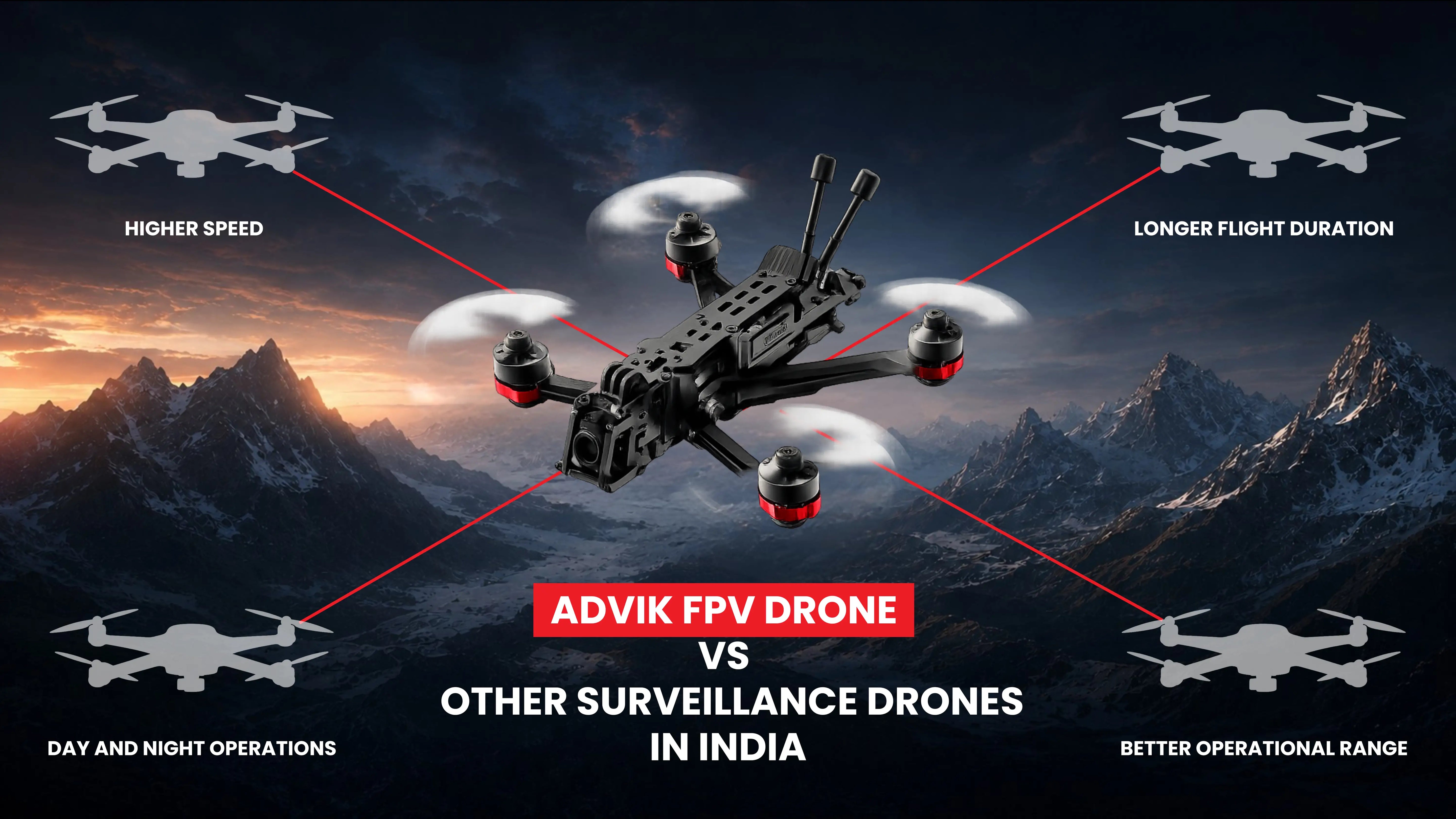

Modern warfare is changing faster than ever before. A few years ago, drones were primarily associated with long-range surveillance missions and high-altitude reconnaissance. Today, however, the battlefield looks very different. From urban combat zones and mountain operations to border surveillance and rapid tactical strikes, militaries are demanding systems that are agile, responsive, and deployable within minutes.
And that is where the debate begins: Multirotor or Fixed-Wing?
For years, fixed-wing drones dominated military discussions because of their long endurance and extended range. But recent conflicts across the world have highlighted a major shift. On today’s battlefield, the ability to hover, maneuver in tight spaces, launch instantly, and operate close to troops often matters more than simply flying farther.
The rise of FPV combat drones, tactical ISR platforms, and autonomous strike systems has proven one thing clearly - in many defence scenarios, multirotor drones are becoming the preferred choice.
Understanding the Two Platforms
Before comparing performance, it is important to understand how both drone categories operate.
What Are Fixed-Wing Drones?
Fixed-wing drones function similarly to conventional aircraft. They rely on wings to generate lift and usually require forward motion to stay airborne.
These drones are traditionally used for:
-
Long-range surveillance
-
High-altitude reconnaissance
-
Border monitoring
-
Mapping large geographical areas
Because of their aerodynamic efficiency, fixed-wing UAVs can travel longer distances with lower energy consumption.
However, they also come with operational limitations. Most fixed-wing systems require runways, catapults, or launch systems for takeoff and recovery. They cannot hover over a target, making precision observation in confined environments more difficult.
What Are Multirotor Drones?
Multirotor drones generate lift through multiple rotors and can take off vertically without requiring runways or launch systems.
Their biggest advantage lies in flexibility.
Multirotor platforms can:
-
Hover over targets
-
Operate in confined environments
-
Launch from rooftops, trenches, vehicles, or forests
-
Conduct precise low-altitude missions
-
Support troops in real-time combat scenarios
Unlike fixed-wing systems, multirotor drones excel in close-range tactical operations where precision and maneuverability are critical.
And in modern warfare, those requirements are becoming increasingly common.
The Battlefield Has Changed
A decade ago, drone warfare focused heavily on strategic surveillance. Today, conflicts are being influenced by squad-level drone operations.
Small drone teams are now assisting soldiers with:
-
Real-time reconnaissance
-
Artillery correction
-
Building clearance
-
Precision strikes
-
Kamikaze missions
-
Logistics support
-
Electronic warfare
Recent battlefield developments have demonstrated the effectiveness of compact FPV and multirotor systems in urban and trench warfare.
The modern battlefield is no longer open and predictable. It is dense, dynamic, and fast-moving.
And that environment favors multirotor drones.
Why Multirotor Drones Are Gaining the Advantage
1. Vertical Takeoff and Landing Changes Everything
A fixed-wing drone may need a launch strip or recovery zone.
A multirotor drone needs only a few square feet.
That difference becomes critical during military operations.
Imagine a special forces unit operating in mountainous terrain. There is no runway. No catapult system. No time for setup.
A multirotor drone can launch directly from a backpack case, provide live ISR within seconds, and land safely beside the operator after the mission.
This rapid deployment capability gives armed forces a massive tactical advantage.
2. Hover Capability Enables Precision Operations
Fixed-wing drones are always moving forward. That makes persistent observation difficult in compact combat environments.
Multirotor drones can hover directly above a target area for extended periods.
This allows operators to:
-
Track enemy movement
-
Observe buildings or trenches
-
Guide artillery fire
-
Conduct precision payload drops
-
Maintain visual lock on moving targets
In urban warfare, hovering capability often becomes more valuable than endurance itself.
3. Superior Performance in Urban Warfare
Modern defence operations increasingly occur in cities, border villages, forests, and infrastructure-heavy environments.
These are exactly the environments where fixed-wing drones struggle.
A fixed-wing platform cannot easily maneuver between buildings or maintain stable observation near structures. Multirotor systems, however, are built for confined-space operations.
They can:
-
Fly through narrow passages
-
Operate inside damaged infrastructure
-
Inspect hostile compounds
-
Support indoor reconnaissance
-
Navigate dense obstacles
This is one of the primary reasons multirotor FPV drones have become highly effective in tactical combat roles.
4. Faster Deployment During Emergencies
Military decisions are often made in seconds.
Fixed-wing systems may require assembly, launch preparation, and recovery planning.
Multirotor drones dramatically reduce operational delay.
Troops can deploy them instantly during:
-
Ambush situations
-
Border intrusions
-
Counter-terror operations
-
Search-and-rescue missions
-
Convoy protection
This responsiveness directly improves situational awareness and survivability.
5. Better for Precision Strike and Kamikaze Missions
Modern combat increasingly relies on low-cost precision strike systems.
Multirotor drones have become extremely effective in:
-
FPV strike missions
-
Anti-vehicle attacks
-
Precision munition delivery
-
Low-altitude tactical engagement
Because they can hover and maneuver precisely, operators gain far greater control during terminal targeting.
Fixed-wing drones may carry larger payloads over longer distances, but multirotors provide better precision at close range.
And in tactical warfare, precision often wins over scale.
Where Fixed-Wing Drones Still Perform Better
Despite the growing dominance of multirotor platforms, fixed-wing drones still have advantages in certain missions.
They remain useful for:
-
Long-endurance border patrol
-
Wide-area surveillance
-
High-altitude reconnaissance
-
Large-scale mapping operations
-
Long-distance logistics
Fixed-wing systems are more energy-efficient and generally offer greater flight range.
However, these advantages become less important when missions require agility, precision, rapid deployment, or close-range engagement.
That is why many modern defence programs are increasingly investing in tactical multirotor fleets.
Detailed Defence Case Studies: Multirotor vs Fixed-Wing Drone Operations
Case Study 1: Ukraine–Russia War (Eastern Ukraine)
FPV Multirotor Drones Changing Modern Warfare
The ongoing conflict between Ukraine and Russia has become one of the biggest demonstrations of modern drone warfare in history.
Initially, fixed-wing drones were widely used for long-range reconnaissance and artillery spotting. However, as trench warfare and urban combat intensified in regions like Donetsk, Bakhmut, and Avdiivka, militaries rapidly shifted toward multirotor FPV drones.
What Were the Drones Used For?
Multirotor drones were deployed for:
-
Real-time trench surveillance
-
FPV kamikaze strike missions
-
Tank and armored vehicle attacks
-
Artillery correction
-
Close-range reconnaissance
-
Urban combat intelligence gathering
Small FPV quadcopters became especially effective because they could fly directly into narrow trenches, damaged buildings, and forested combat zones where fixed-wing drones struggled to operate effectively.
Why Multirotors Performed Better
Fixed-wing drones provided longer endurance but faced limitations:
-
Could not hover over enemy trenches
-
Less effective in dense urban zones
-
Required larger launch and recovery areas
-
Easier to detect during repeated surveillance passes
Multirotor drones, on the other hand:
-
Could launch directly from frontline trenches
-
Hover precisely over targets
-
Maneuver between structures
-
Deliver extremely accurate strikes
-
Operate at low altitude with reduced detection risk
The war demonstrated that tactical battlefield dominance increasingly depends on agility and precision rather than only range. FPV multirotor drones became one of the most cost-effective combat systems of the conflict.
Case Study 2: Counter-Terror Operations in Kashmir (India)
In regions of Jammu and Kashmir, the Indian Army and Indian security forces have increasingly adopted multirotor drones for counter-insurgency and border surveillance operations.
The terrain in Kashmir includes:
-
Dense forests
-
Mountain valleys
-
Urban settlements
-
Narrow infiltration routes
These environments make fixed-wing operations difficult for close tactical missions.
Operational Use
Multirotor drones have been used for:
-
Real-time surveillance during anti-terror raids
-
Monitoring infiltration routes near the Line of Control (LoC)
-
Building and compound inspection
-
Convoy protection
-
Night reconnaissance
Why Multirotors Were More Effective
In mountainous terrain, multirotor drones offered several advantages:
-
Vertical takeoff from small military posts
-
Ability to hover behind ridgelines
-
Precision surveillance over villages and forests
-
Easier deployment during rapid-response operations
Fixed-wing systems remained useful for broader border monitoring, but multirotors proved far more practical during active tactical operations where troops required instant visual intelligence.
Case Study 3: Israel–Hamas Urban Warfare (Gaza Strip)
The conflict between Israel and Hamas highlighted how urban warfare heavily favors multirotor drone systems.
Combat operations in the Gaza Strip involved dense civilian infrastructure, underground tunnels, and close-quarter engagements.
Mission Roles
Multirotor drones were extensively used for:
-
Urban reconnaissance
-
Building clearance support
-
Tunnel entrance identification
-
Precision strike coordination
-
Real-time battlefield surveillance
Why Fixed-Wing Platforms Struggled
Urban warfare created several operational problems for fixed-wing UAVs:
-
Limited maneuverability between buildings
-
Difficulty maintaining persistent observation
-
Higher risk during low-altitude urban passes
Multirotor drones solved many of these challenges through hovering and precise maneuverability.
Troops could deploy compact drones from armored vehicles or rooftops and immediately gain visual intelligence over hostile zones.
This significantly improved operational awareness in one of the most infrastructure-dense combat environments in the world.
Final Verdict: Which Platform Performs Better?
The answer ultimately depends on mission requirements.
If the objective is long-range surveillance across vast territories, fixed-wing drones still provide value.
But if the mission demands:
-
Tactical flexibility
-
Rapid deployment
-
Precision engagement
-
Urban maneuverability
-
Real-time ISR
-
Hover capability
-
Close-range combat support
Then multirotor drones clearly outperform fixed-wing systems.
Modern warfare is no longer only about flying farther.
It is about reacting faster, seeing clearer, and striking more precisely.
And that is exactly where multirotor platforms dominate.
Frequently Asked Questions (FAQs)
Are multirotor drones better than fixed-wing drones for military use?
For tactical military applications such as ISR, FPV strike missions, urban warfare, and rapid deployment, multirotor drones are often more effective due to their hovering capability and maneuverability.
Why are multirotor drones widely used in modern warfare?
Multirotor drones can launch quickly, operate in confined environments, hover over targets, and support precision missions in real-time combat scenarios.
What is the biggest advantage of fixed-wing drones?
Fixed-wing drones offer longer endurance and greater flight range, making them suitable for large-area surveillance and long-distance reconnaissance missions.
Why are FPV drones becoming important in defence operations?
FPV multirotor drones provide highly precise low-altitude strike capability at relatively low cost, making them extremely effective in tactical combat.
Can multirotor drones replace fixed-wing drones completely?
Not entirely. Both platforms serve different operational purposes. However, multirotor drones are increasingly becoming the preferred choice for tactical and close-range military operations.
Which drone platform is better for urban warfare?
Multirotor drones are significantly better suited for urban warfare because they can hover, maneuver around structures, and operate effectively in confined environments.
Are hybrid drones the future of military UAVs?
Hybrid drones are gaining attention because they combine VTOL capability with improved endurance. However, they are still more complex compared to conventional multirotor systems.