
India's drone industry just got its most serious policy push yet. The Ministry of Civil Aviation has proposed a ₹1,600 to ₹1,800 crore scheme over five years, called Mission Drone Shakti, with one clear goal: make India stop depending on China for drone components and start making them here.
This is not another adoption scheme and this is not about subsidising drone services or training pilots.
This is about building the actual parts that go inside drones, right here in India.
Why Now? The Ukraine War Said It All
If you want to understand why component-level manufacturing matters so much, look at what happened in Ukraine.
The conflict became the world's most brutal live demonstration of drone warfare, and also its most brutal lesson in supply chain vulnerability.
Here is what unfolded:
-
Nearly every drone used on both sides of the conflict, from small FPV units guiding artillery strikes to long-range loitering munitions, contained Chinese-made components
-
In September 2024, China imposed export restrictions on drone parts going to Ukraine, including flight controllers, motors, carbon frames, radio modules, and navigation cameras
-
Ukraine, which had increased its drone production to millions of units annually, found its entire supply chain choked overnight by a country it had no diplomatic leverage over
-
Chinese manufacturers currently control somewhere around 80% of global drone component production, which means one policy decision in Beijing can shut down your entire drone programme
India watched all of this. And the people writing this scheme clearly understood that supply chain dependency is not just an economic problem but it is a national security problem.
What Mission Drone Shakti Actually Proposes
This scheme is different from previous drone policy in one important way: it goes after components, not finished products.
That is the right call, and here is what it covers:
-
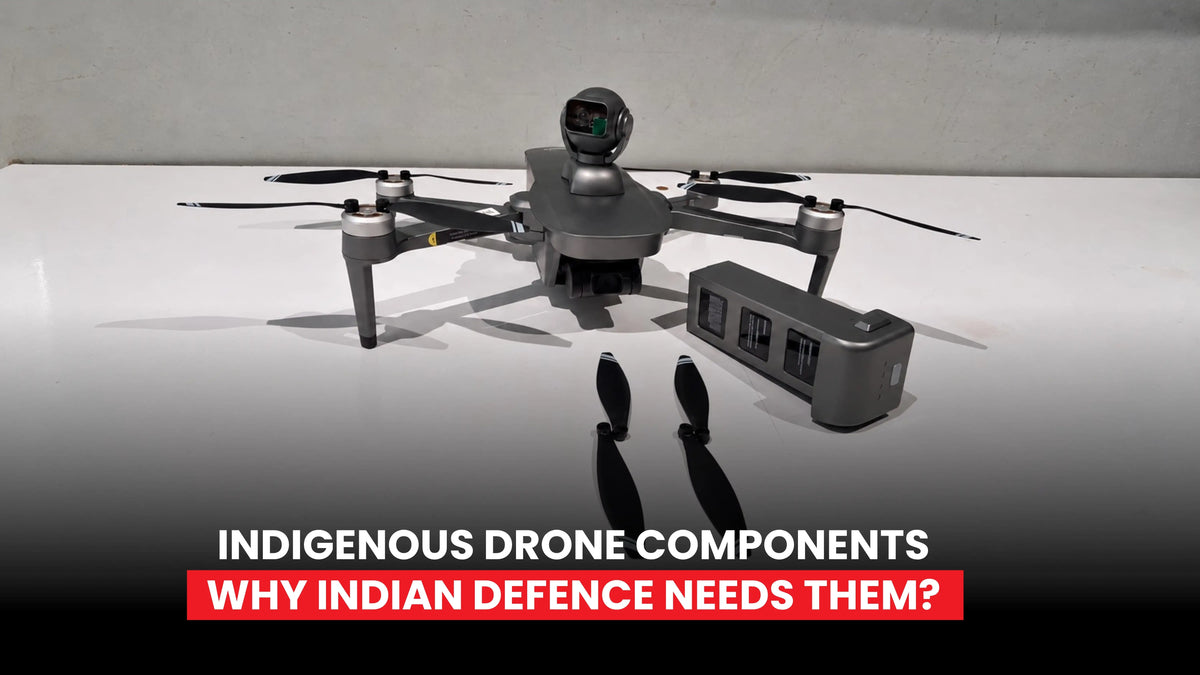
Motors - currently almost entirely imported from China
-
Sensors - ranging from barometers and IMUs to LiDARs and cameras
-
Batteries - LiPo and Li-ion cells, which even US drone companies depend on Chinese factories for
-
Propellers and airframes - precision manufacturing that India has the engineering base to do, but hasn't scaled yet
-
Flight controllers and ESCs - the brains of every drone, currently a Chinese monopoly in the affordable segment
The incentive structure is also designed smartly. Companies that set up manufacturing units earlier in the five year window get higher benefits.
That is a deliberate push to get serious players moving fast rather than waiting to see how the scheme plays out.
The Component Gap Is What Actually Matters
A lot of people in the industry will tell you India already assembles drones. That is true. But assembly is not manufacturing, and the difference matters enormously.
Think of it this way:
-
Assembling a drone from imported parts means your entire supply chain can be cut off by a single export restriction from China
-
Actual component manufacturing means you control costs, quality, timelines, and availability end to end
-
Defence applications especially cannot afford to rely on adversarial nations for critical parts during a conflict
-
Even civilian drone programmes for agriculture, logistics, and surveillance become unreliable when global component prices spike or shipments get delayed
India has engineering talent. It has competitive labour costs. It has a huge and growing domestic demand base across agriculture, infrastructure, defence, and mapping.
What it has lacked is a structured financial incentive to push companies deeper into the manufacturing stack. Mission Drone Shakti is that push.
What This Means for Indian Drone Manufacturers
At InsideFPV, we have been building drones in India because we believe the capability exists here to do it properly. This scheme, if executed with the same seriousness as the PLI programme for electronics, opens a real door for companies to invest in component-level R&D.
It also includes moving away from supply chains that were never fully in our control.
The broader opportunity looks like this:
-
Thousands of engineering and manufacturing jobs across the drone value chain
-
A domestic component supplier ecosystem that can serve both defence and civilian OEMs
-
Reduced import costs over time as local alternatives become available and competitive
-
India positioning itself as a genuine drone exporter to global markets, not just a buyer
The Bottom Line
The Ukraine conflict made one thing clear to every defence planner and technology manufacturer watching: if you cannot build the parts yourself, you do not really own your capability. You are just renting it from whoever controls the supply chain.
India has the chance to fix that before a crisis forces the issue. Mission Drone Shakti is not a guarantee, but it is the most serious attempt yet to make Indian drone manufacturing real from the ground up.
Frequently Asked Questions
What is Mission Drone Shakti?
Mission Drone Shakti is a proposed ₹1,600–₹1,800 crore government scheme aimed at increasing domestic manufacturing of drone components in India over five years.
Why is India focusing on drone component manufacturing?
India wants to reduce its dependence on Chinese imports and secure its supply chain, especially after global disruptions highlighted during the Ukraine conflict.
How will Mission Drone Shakti impact the drone industry in India?
The scheme is expected to create jobs, lower import costs, strengthen defence capabilities, and help Indian companies become global drone exporters.