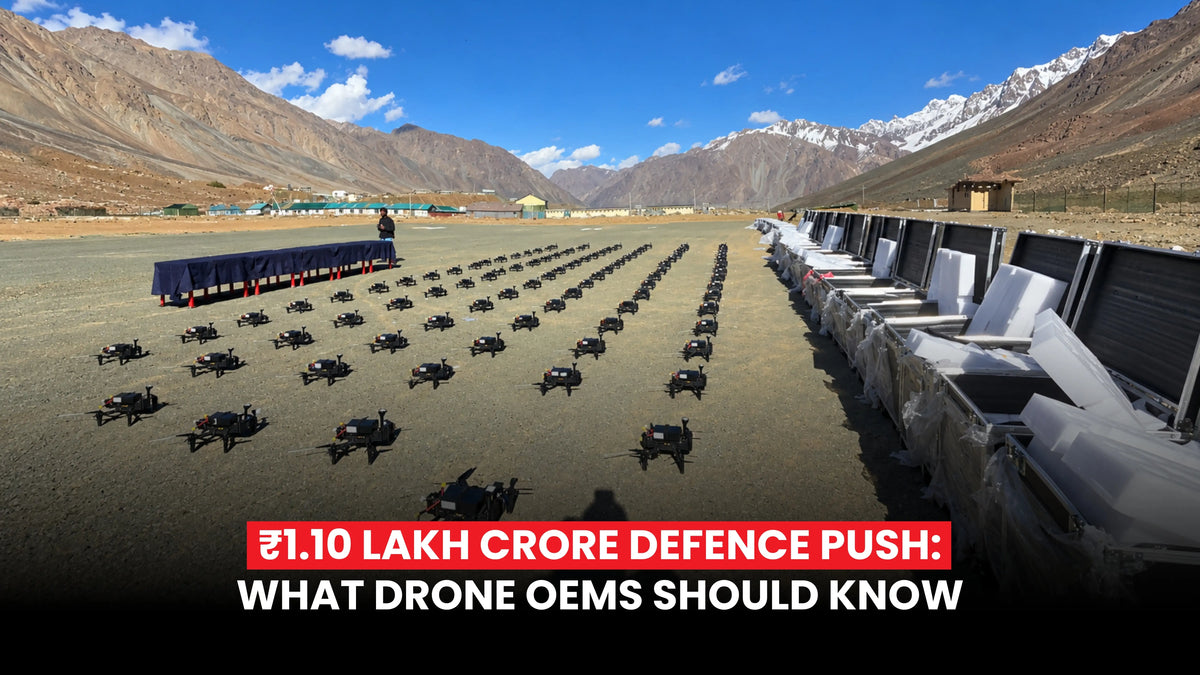

Dronathon 2026 highlights three technology priorities for the Indian Air Force: autonomous aircraft that perform defined tasks with less continuous operator input, drones that coordinate as a group, and systems designed to retain essential functions when communications or satellite navigation are disrupted. Their effectiveness depends on software, sensors, communications and testing as much as the airframe.
The Ministry of Defence identified autonomy, swarm technologies and electronic warfare among the event’s focus areas. Its announcement also confirmed the release of an IAF UAS Roadmap to guide industry development. These are priorities for evaluation and development; the announcement does not establish that every demonstrated capability has entered service. Source: Ministry of Defence, 14 September 2026
Three technology directions and what each contributes
An unmanned aircraft system, or UAS, includes the aircraft, control equipment, software and communications needed to operate it.
| Direction | Main function | Key qualification |
|---|---|---|
| Autonomous UAS | Perform defined tasks with reduced operator input. | Independence varies by task and operating conditions. |
| Coordinated drones | Share information and organise group activity. | Multiple aircraft do not automatically form an autonomous swarm. |
| EW resilience | Preserve specified functions under electromagnetic interference. | Performance depends on the system and tested conditions. |
These capabilities overlap, but each requires its own evidence. Autonomous navigation does not establish swarm coordination, and a protected communication link does not guarantee accurate navigation.
Autonomous UAS: define what operates independently
Autonomy concerns the decisions a system makes within its assigned role. Depending on its design, a drone might assist with navigation, monitor equipment health or respond to changes without requiring a pilot to direct every action.
Following a fixed route demonstrates automation. Assessing autonomy also requires understanding how the aircraft responds when conditions change or information becomes unreliable.
For autonomous military drones in India, a useful capability description should identify:
-
The functions that operate independently.
-
The conditions in which those functions have been tested.
-
The information available to the operator.
-
The decisions that require human authorisation.
-
The response when the system reaches its operating limits.
Autonomy and artificial intelligence are related but distinct. AI supports functions such as perception and information processing in some systems. Other functions use conventional control software. An AI label alone does not establish independent or dependable operation.
NASA research on human autonomy teaming examines interactions between operators, automated systems and other aircraft. It illustrates why the human interface deserves attention alongside onboard capability.
Autonomous flight and autonomous weapon employment also require separate assessment. Independence in navigation does not establish authority to select or engage a target.
Operating without GPS requires separate validation
An autonomous drone might still depend on satellite navigation. Losing GPS can affect position estimation even while other onboard functions continue working.
Conversely, a manually piloted FPV drone does not necessarily need GPS for basic flight. That does not establish autonomous navigation or recovery after loss of the control link.
The distinction matters when comparing products. Buyers should establish which functions remain available without satellite positioning and under which conditions.
Read insideFPV’s guide to how defence FPV drones navigate without GPS for a fuller explanation of navigation options and their limitations.
Coordinated drones: evaluate the group’s behaviour
Coordinated drones exchange information or operate under shared management to perform related tasks. Swarm capability involves collective behaviour, with the level of cooperation and adaptation depending on the system.
The US Department of Defense’s Perdix demonstration reported collective decision making and adaptive group behaviour. It illustrates swarm functionality without establishing anything about Indian deployment.
For swarm drones intended for the Indian Air Force, aircraft count provides only part of the picture. Evaluation should also address operator workload, shared information, safe separation and the group’s response when aircraft or connections become unavailable.
Adding aircraft increases the number of interactions that require management. A successful demonstration therefore needs further evidence before its results are applied to different environments or larger groups.
The practical requirement is predictable group behaviour within clearly defined limits.
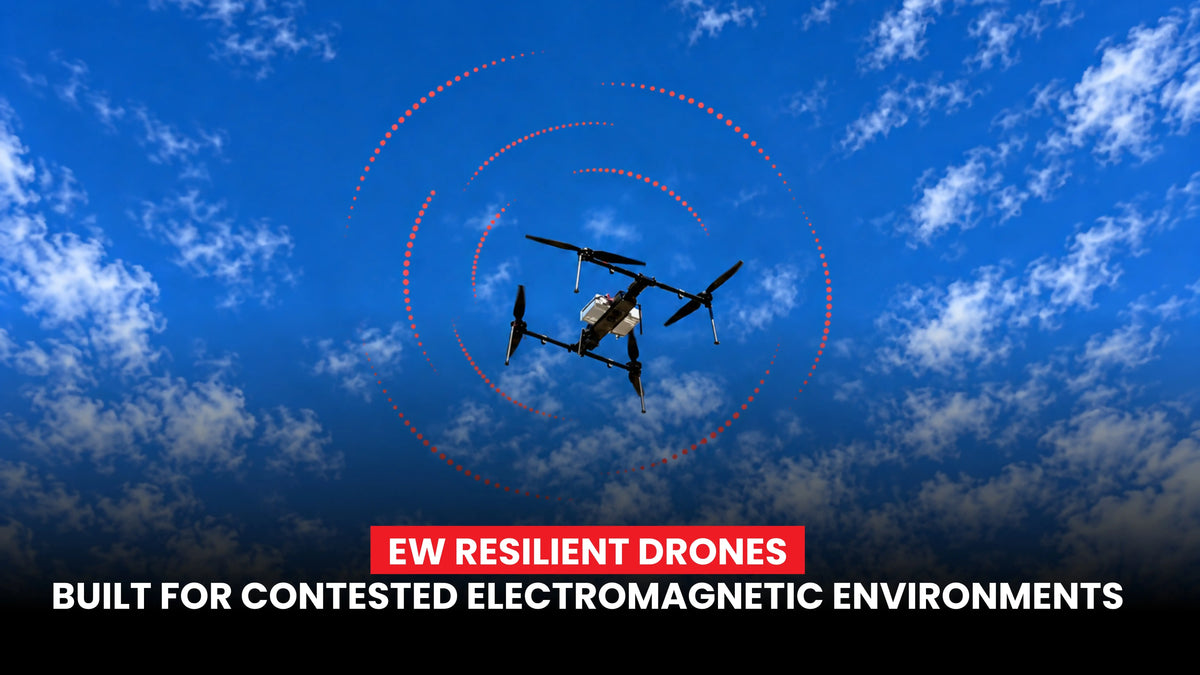
EW ready drones: identify the function being protected
A contested electromagnetic environment exposes communications, navigation or sensing to interference. Sources include deliberate disruption and unintended interference.
Jamming and spoofing are distinct threats. Jamming can overwhelm legitimate navigation signals. Spoofing introduces false signals intended to mislead the receiver. The European Space Agency identifies both as threats to reliable satellite navigation.
The term “electronic warfare drone” also needs context. An aircraft carrying an EW payload has a different role from an aircraft designed to resist interference.
A useful EW resilience claim identifies the protected function and its limits.
| Claim | Evidence to request |
|---|---|
| Navigation without GPS | Functions retained, accuracy limits and test conditions. |
| Resistance to jamming | Link or receiver tested and performance under interference. |
| Secure communications | Security protections and their scope. |
| Continued operation | Functions retained, functions lost and operator notifications. |
Encryption supports data security. It does not, by itself, prevent radio interference. Maintaining a control link also does not necessarily preserve navigation accuracy or sensor data quality.
A successful test under one interference condition establishes evidence for that condition, not universal protection. Explore insideFPV’s explanation of anti jamming drones and electronic warfare for further context.
Fibre optic control protects a specific data path
Fibre optic FPV drones carry commands and video through a physical optical cable. Conventional radio frequency jamming cannot directly disrupt data travelling through that fibre.
Other limitations remain. Cable damage can interrupt the connection, the spool adds weight, and a separate satellite navigation receiver remains exposed to interference affecting its signals.
Fibre optic control does not automatically provide autonomy or swarm coordination. Its contribution concerns the communication path.
Read insideFPV’s guide to fibre optic FPV drones in electronic warfare environments for the benefits and tradeoffs.
What this means for insideFPV and Indian drone manufacturers
insideFPV presents its offering around drone platforms, training, maintenance, repairs and technical support. Its website also identifies contested electromagnetic environments as a design consideration.
For an original equipment manufacturer, or OEM, these requirements extend across the complete system. A capable airframe needs dependable software, compatible equipment, clear operator interfaces and support throughout its service life.
An Indian military drone supplier should distinguish a development objective from a demonstrated capability and an available product configuration. Buyers need evidence tied to the specific aircraft, software and equipment being offered.
For insideFPV, this provides a practical basis for discussing autonomy, coordination, communication constraints and the training required alongside a platform.
Discuss your requirements with insideFPV: Contact the team to discuss platform suitability, available capability documentation, training and support.
A practical checklist for evaluating drone capability claims
Use this checklist to organise an initial supplier discussion. It supports comparison and does not replace formal trials or procurement requirements.
| Check | What to record |
|---|---|
| Intended task | The function the system must perform. |
| Configuration | Aircraft, payload, software version and ground equipment. |
| Autonomy | Independent functions and decisions reserved for the operator. |
| Coordination | Group behaviour demonstrated and conditions tested. |
| Navigation | Dependencies and behaviour without reliable satellite positioning. |
| Communications | Functions affected by a degraded or lost link. |
| Evidence | Test conditions, results, limitations and unresolved issues. |
| Support | Training, maintenance, spares and software support arrangements. |
Keep proposed features separate from tested functions when completing the checklist. If the evidence covers a different configuration, ask the supplier to explain whether the result applies to the offered system.
Frequently asked questions
Did Dronathon 2026 confirm new IAF procurement contracts?
The Ministry of Defence announcement reviewed for this article describes technology assessment and the release of a UAS roadmap. It does not establish a procurement award for every participating system. Contract claims require separate official confirmation. Source: Ministry of Defence
Does a drone need AI to operate autonomously?
Not every autonomous function requires AI. Conventional control software supports many automated functions, while AI supports tasks such as interpreting sensor information in some systems. Evaluation should focus on demonstrated behaviour and limitations rather than the AI label.
Does losing the control link mean a drone will crash?
The outcome depends on the aircraft’s design, available navigation inputs and configured response. Some systems support an automatic recovery or landing response. Continued safe flight should only be claimed within the conditions for which that response has been validated.
Does a fibre optic drone still need navigation equipment?
The optical cable carries data between the aircraft and operator; it does not determine the aircraft’s position. Navigation requirements depend on whether the pilot directs the flight manually or the system performs functions that require its own position estimate.
How should buyers compare two EW resilience claims?
Check whether both claims refer to the same function, configuration, interference conditions and performance measure. A result concerning control link availability is not directly comparable with one concerning navigation accuracy. Where the evidence differs, request clarification before drawing a conclusion.
Explore insideFPV drone platforms and support offering for further information about available systems and services.